

As a seasoned supplier of stainless steel plates and sheets, I often encounter customers who need to calculate the weight of these products for various reasons, such as transportation planning, cost estimation, or structural design. In this blog post, I'll share a comprehensive guide on how to calculate the weight of stainless steel plates and sheets, along with some practical examples and tips.
Understanding the Basics of Stainless Steel Weight Calculation
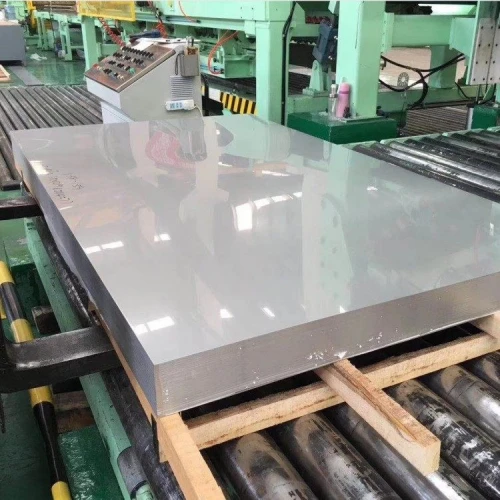
The weight of a stainless steel plate or sheet is primarily determined by its volume and the density of the specific stainless steel grade. The basic formula for calculating the weight of any solid object is:
[
\text{Weight} = \text{Volume} \times \text{Density}
]

Let's break down these components and understand how they apply to stainless steel plates and sheets.
Volume Calculation
The volume of a stainless steel plate or sheet can be calculated using the formula for the volume of a rectangular prism, which is:
[
\text{Volume} = \text{Length} \times \text{Width} \times \text{Thickness}
]
Here, the length, width, and thickness should be measured in the same units (e.g., meters, centimeters, or inches). For example, if you have a stainless steel plate with a length of 2 meters, a width of 1 meter, and a thickness of 0.01 meters, the volume would be:
[
\text{Volume} = 2 \text{ m} \times 1 \text{ m} \times 0.01 \text{ m} = 0.02 \text{ m}^3
]
Density of Stainless Steel
The density of stainless steel varies depending on its grade and composition. Different grades of stainless steel have different amounts of alloying elements such as chromium, nickel, and molybdenum, which affect their density. Here are some common densities for popular stainless steel grades:
- 304 Stainless Steel: Approximately 7.93 g/cm³ or 7930 kg/m³
- 316 Stainless Steel: Approximately 7.98 g/cm³ or 7980 kg/m³
- 430 Stainless Steel: Approximately 7.75 g/cm³ or 7750 kg/m³
It's important to use the correct density for the specific grade of stainless steel you're working with to ensure accurate weight calculations.
Step-by-Step Guide to Calculating the Weight of Stainless Steel Plates and Sheets
Now that we understand the basic concepts, let's go through a step-by-step guide on how to calculate the weight of a stainless steel plate or sheet.
Step 1: Measure the Dimensions
Use a measuring tape or caliper to measure the length, width, and thickness of the stainless steel plate or sheet. Make sure to measure in the same units (e.g., inches or millimeters).
Step 2: Determine the Stainless Steel Grade
Identify the grade of stainless steel you're working with. This information is usually provided by the manufacturer or supplier. If you're unsure, you can perform a simple test or consult a metallurgist.
Step 3: Find the Density of the Stainless Steel Grade
Look up the density of the specific stainless steel grade you've identified. You can find this information in technical manuals, online resources, or by contacting the manufacturer or supplier.
Step 4: Calculate the Volume
Using the formula for the volume of a rectangular prism, calculate the volume of the stainless steel plate or sheet. Make sure to use the same units for all dimensions.
Step 5: Calculate the Weight
Multiply the volume by the density to calculate the weight of the stainless steel plate or sheet. If you're using the metric system, the weight will be in kilograms. If you're using the imperial system, the weight will be in pounds.
Example Calculations
Let's look at some example calculations to illustrate the process.
Example 1: 304 Stainless Steel Plate
Suppose you have a 304 stainless steel plate with a length of 2 meters, a width of 1 meter, and a thickness of 0.01 meters.
- Calculate the volume:
[
\text{Volume} = 2 \text{ m} \times 1 \text{ m} \times 0.01 \text{ m} = 0.02 \text{ m}^3
] - Find the density:
The density of 304 stainless steel is approximately 7930 kg/m³. - Calculate the weight:
[
\text{Weight} = 0.02 \text{ m}^3 \times 7930 \text{ kg/m}^3 = 158.6 \text{ kg}
]
Example 2: 316 Stainless Steel Sheet
Suppose you have a 316 stainless steel sheet with a length of 50 inches, a width of 20 inches, and a thickness of 0.1 inches.
- Calculate the volume:
[
\text{Volume} = 50 \text{ in} \times 20 \text{ in} \times 0.1 \text{ in} = 100 \text{ in}^3
] - Find the density:
The density of 316 stainless steel is approximately 0.289 lb/in³. - Calculate the weight:
[
\text{Weight} = 100 \text{ in}^3 \times 0.289 \text{ lb/in}^3 = 28.9 \text{ lb}
]
Special Considerations
- Surface Finish: The surface finish of a stainless steel plate or sheet can add a small amount of weight. However, this is usually negligible for most applications.
- Cutting and Machining: If the stainless steel plate or sheet has been cut or machined, the weight may be slightly less than the calculated weight due to material removal.
- Holes and Cutouts: If the plate or sheet has holes or cutouts, you'll need to subtract the volume of these features from the total volume before calculating the weight.
Popular Stainless Steel Grades and Their Applications
In addition to the common grades mentioned above, there are many other stainless steel grades available, each with its own unique properties and applications. Here are some popular grades and their typical uses:
- S34700 Stainless Steel Plate: This grade is known for its excellent resistance to intergranular corrosion and high-temperature strength. It's commonly used in applications such as chemical processing, power generation, and aerospace.
- ASTM A240 TP 316L Stainless Steel Plates: The "L" in 316L stands for low carbon, which makes this grade more resistant to sensitization and corrosion in welded structures. It's widely used in the food and beverage industry, pharmaceutical manufacturing, and marine applications.
- S31008 Stainless Steel Plate: This grade has excellent high-temperature oxidation resistance and is often used in applications such as furnace components, heat exchangers, and kiln linings.
Conclusion
Calculating the weight of stainless steel plates and sheets is a straightforward process once you understand the basic principles. By following the steps outlined in this blog post and using the correct density for the specific grade of stainless steel, you can accurately determine the weight of your products.
If you're in the market for high-quality stainless steel plates and sheets, we're here to help. As a trusted supplier, we offer a wide range of grades and sizes to meet your specific needs. Whether you're a small business or a large industrial manufacturer, we can provide you with the products and expertise you need to succeed.
Contact us today to discuss your requirements and get a quote. We look forward to working with you!
References
- ASM Handbook, Volume 1: Properties and Selection: Irons, Steels, and High-Performance Alloys
- The Stainless Steel Book, Second Edition by George E. Totten and D. Scott MacKenzie
- Technical Data Sheets from Stainless Steel Manufacturers


