

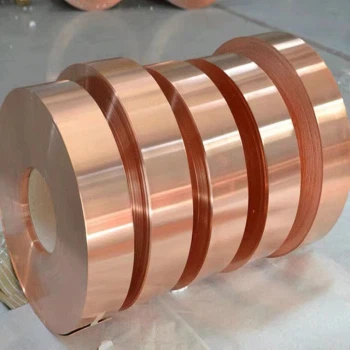
Hey there! As a supplier of C26000, I often get asked about the best welding methods for this particular copper alloy. C26000, also known as cartridge brass, is a popular choice in various industries due to its excellent formability, corrosion resistance, and good mechanical properties. So, let's dive into the welding methods that work well with C26000.
1. Gas Tungsten Arc Welding (GTAW)
Gas Tungsten Arc Welding, or GTAW for short, is a great option for welding C26000. It's also commonly referred to as TIG (Tungsten Inert Gas) welding. One of the main advantages of GTAW is its ability to provide precise control over the welding process. This is crucial when working with C26000 because it allows you to maintain the integrity of the alloy's properties.
In GTAW, a non - consumable tungsten electrode is used to create an arc between the electrode and the workpiece. An inert gas, usually argon, is used to shield the weld area from atmospheric contamination. This shielding gas prevents oxidation and other unwanted reactions that could weaken the weld.
When welding C26000 with GTAW, you need to pay attention to the welding parameters. The welding current, voltage, and travel speed all play important roles in achieving a high - quality weld. Generally, a lower welding current is preferred to avoid overheating the alloy, which can lead to grain growth and a decrease in mechanical properties.
2. Gas Metal Arc Welding (GMAW)
Gas Metal Arc Welding, or GMAW (also known as MIG - Metal Inert Gas welding), is another viable option for C26000. In GMAW, a consumable wire electrode is fed continuously through a welding gun, and an inert gas is used to shield the weld.
One of the benefits of GMAW is its high welding speed. This makes it suitable for large - scale production where efficiency is key. However, when using GMAW on C26000, you need to be careful with the heat input. Excessive heat can cause the alloy to distort or develop porosity in the weld.
To ensure a good weld with GMAW, you should select the appropriate filler wire. A filler wire with a similar composition to C26000 is usually recommended. This helps to match the properties of the base metal and the weld metal, resulting in a stronger and more durable joint.
3. Resistance Welding
Resistance welding is a group of welding processes that use the heat generated by the resistance to electric current flow through the workpieces to create a weld. There are several types of resistance welding, such as spot welding and seam welding, which can be used for C26000.
Spot welding is a popular choice for joining thin sheets of C26000. In spot welding, two electrodes are placed on either side of the workpieces, and a high - current pulse is passed through the electrodes. The heat generated at the contact points between the electrodes and the workpieces melts the metal, creating a weld nugget.
Seam welding is similar to spot welding, but instead of creating individual weld spots, a continuous seam is formed. This is useful for applications where a leak - tight joint is required, such as in the manufacturing of tubes or containers.
Resistance welding has the advantage of being a fast and efficient process. It also produces minimal distortion and does not require any filler material. However, it requires specialized equipment and careful control of the welding parameters to ensure consistent and high - quality welds.
4. Brazing
Brazing is a joining process where a filler metal with a lower melting point than the base metal is heated above its melting point and flowed into the joint by capillary action. For C26000, brazing can be a good option, especially when you need to join dissimilar metals or when you want to avoid the high heat input associated with welding.
There are different types of brazing, such as torch brazing and furnace brazing. Torch brazing is a manual process where a torch is used to heat the joint and melt the filler metal. Furnace brazing, on the other hand, is a more automated process where the workpieces are placed in a furnace and heated to the brazing temperature.
When brazing C26000, you need to choose the right filler metal. Copper - based filler metals are often used because they have good compatibility with C26000. The joint design is also important in brazing. A proper joint clearance is required to allow the filler metal to flow smoothly into the joint.

Comparing with Other Copper Alloys
It's interesting to compare the welding methods of C26000 with other copper alloys like C17510 Beryllium Copper, C26800 Brass, and UNS C11000 Copper.
C17510 Beryllium Copper has high strength and good conductivity. However, it contains beryllium, which can be toxic if inhaled during welding. So, special safety precautions are required when welding this alloy. The welding methods for C17510 are similar to those for C26000, but more attention needs to be paid to the shielding gas and ventilation.
C26800 Brass has different mechanical and chemical properties compared to C26000. It has a higher zinc content, which can affect the welding process. When welding C26800, the risk of zinc evaporation is higher, which can lead to porosity and other defects in the weld.
UNS C11000 Copper is a pure copper alloy. It has excellent electrical and thermal conductivity. Welding UNS C11000 requires a higher heat input compared to C26000 because of its high thermal conductivity. The welding methods used for UNS C11000 are also similar, but the welding parameters need to be adjusted accordingly.
Conclusion
In conclusion, there are several welding methods suitable for C26000, including GTAW, GMAW, resistance welding, and brazing. Each method has its own advantages and disadvantages, and the choice of welding method depends on various factors such as the application, the thickness of the workpiece, and the production requirements.
If you're in the market for C26000 or have any questions about welding this alloy, don't hesitate to reach out for a procurement discussion. I'm here to help you make the best decisions for your projects.
References
- ASM Handbook Volume 6: Welding, Brazing, and Soldering
- Welding Metallurgy and Weldability of Copper and Copper Alloys by John C. Lippold


